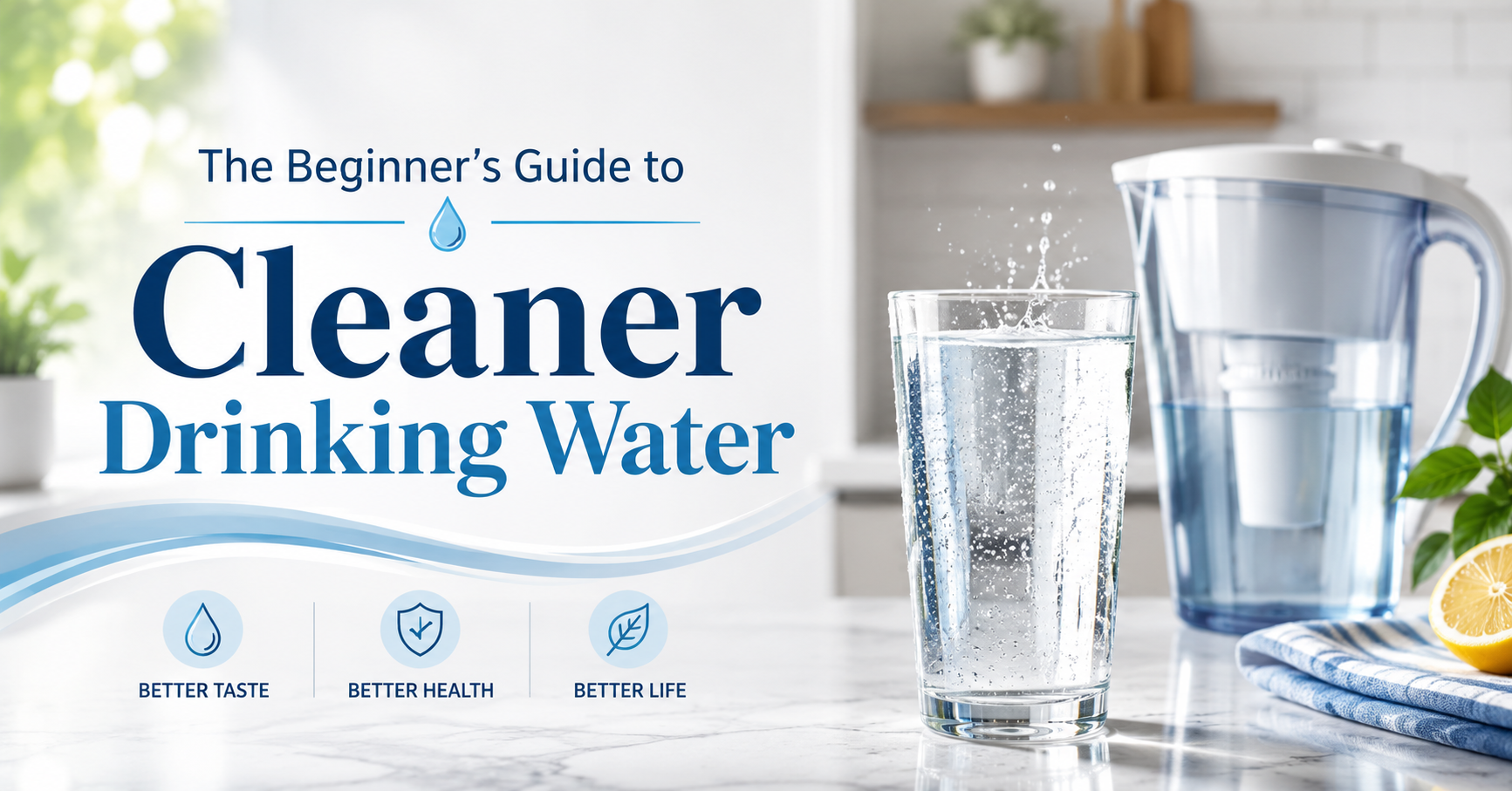
Cleaner drinking water sounds like one of those things that should be simple.
Turn on faucet. Fill glass. Drink water. Feel responsible.
Done.
Except once you start paying attention, you quickly realize water can get confusing fast. There are water reports, contaminants, filters, bottled water, refrigerator filters, countertop systems, reverse osmosis, PFAS, chlorine taste, private wells, and approximately 47 opinions from people on the internet who all sound very confident.
So let’s slow it down.
You do not need to become a water scientist to make better choices for your home. You just need to understand a few basics: where your water comes from, what might be in it, how to check your water quality, and what kind of filter actually makes sense for your life.
Because cleaner drinking water is not about panic.
It is about paying attention to something your family uses every single day. Before you start comparing filters, it helps to understand why water quality matters in the first place.
First, Know Where Your Water Comes From
Before you start shopping for filters or falling into a late-night rabbit hole about contaminants, start with the basics.
Where does your drinking water come from?
For many homes, water comes from a public water system. That means your city, town, or local water supplier treats and monitors the water before it reaches your home. Public water systems in the United States are regulated by the EPA under drinking water rules. The EPA sets legal limits for many contaminants and establishes monitoring requirements for public water systems.
But not every home uses city water.
Some homes use private wells. If your home has a private well, you are responsible for testing and maintaining your water. Private wells are not monitored in the same way public water systems are, so testing becomes much more important. The CDC recommends testing well water at least once a year for total coliform bacteria, nitrates, total dissolved solids, and pH levels.
That is step one: know whether you have city water or well water.
It may not sound exciting, but honestly, a lot of adult life is just finding out who is responsible for something and then realizing, “Oh. It’s me.”
Read Your Local Water Report
If you use public water, your next step is to look up your local water quality report.
This report is called a Consumer Confidence Report, or CCR. It tells you where your water comes from, what was detected in it, and whether anything exceeded legal limits. Community water systems are required to provide these reports each year, usually by July 1.
Is it glamorous reading?
No.
Will it beat a cozy mystery novel?
Also no.
But it can give you helpful information about your actual local water instead of guessing based on taste, smell, or vibes.
You can usually find your report by searching your city or water provider’s name plus “water quality report” or “Consumer Confidence Report.”
Understand That Clear Water Is Not Always the Whole Story
One of the trickiest things about water is that it can look perfectly clear and still contain things you may want to know about.
Some water issues are obvious. Maybe your water smells like chlorine, tastes metallic, looks cloudy, or leaves buildup on your kettle or faucet.
Other issues are not obvious at all.
That does not mean every glass of tap water is dangerous. It simply means appearance is only one part of the story.
Cleaner drinking water starts with curiosity, not fear.
Instead of asking, “Does this water look fine?” a better question is:
What do I actually know about this water?
That question will take you much further than staring suspiciously at your glass like it owes you money.
Decide What You Want to Improve
Before buying any water filter, get clear on your goal.
Are you trying to improve taste?
Reduce chlorine smell?
Address lead concerns?
Reduce PFAS?
Deal with sediment?
Improve water used for coffee, tea, cooking, and ice?
Filter well water?
These are different goals, and they may require different solutions.
This is where people often get stuck. They search for “best water filter,” but that is not always the right question.
The better question is:
What do I want my water filter to reduce?
A basic pitcher filter may improve taste and odor. A more advanced countertop or under-sink system may reduce a wider range of contaminants, depending on its certifications. Reverse osmosis systems work differently than carbon filters. UV systems are different again.
So before you buy, know the problem you are trying to solve.
Your future self will thank you. Possibly while drinking better coffee.
Learn the Difference Between Filter Claims and Certifications
This part matters.
A water filter can say a lot of pretty things on the box. “Fresh.” “Pure.” “Clean.” “Advanced.” “Great-tasting.” “Fancy enough to make you feel like you have your life together.”
But marketing words are not the same as certified reduction claims.
NSF explains that different drinking water treatment standards cover different types of claims. For example, NSF/ANSI 42 relates to aesthetic effects like chlorine taste and odor, NSF/ANSI 53 covers certain health-related contaminants, and NSF/ANSI 401 covers certain emerging compounds or incidental contaminants.
Translation: do not just look at the filter style.
Look at what the filter is certified to reduce.
That does not mean every household needs the most expensive system available. It means you should match the filter to your water concerns instead of buying based only on price, popularity, or how cute it looks next to your coffee maker.
Although, yes, cute does help. We are only human.
Know the Common Types of Drinking Water Filters
There are several types of drinking water filters, and each one has pros and cons.
Pitcher Filters
Disclosure: This post may contain affiliate links. As an Amazon Associate I earn from qualifying purchases. If you purchase through my links, I may earn a commission at no extra cost to you.
If you want to start simple, pitcher filters can be an easy first step. Options like a “Brita water pitcher” or a “Clearly Filtered water pitcher” may work well for people who want something affordable and beginner-friendly before moving into a countertop or under-counter system.
The downside is that they usually have limited capacity, can be slow, and need frequent filter changes. Also, if your family drinks a lot of water, you may spend your life refilling the pitcher like it is your new part-time job.
Faucet-Mounted Filters
These attach directly to your faucet and can be convenient for small kitchens or renters.
They are usually easy to install, but they may not fit every faucet. They can also slow water flow or get in the way depending on your sink setup.
Countertop Filters
Countertop systems sit on your counter and connect to your faucet or work as standalone units. These can be a nice middle-ground option because they often offer more filtration power than a basic pitcher without requiring major installation.
If you’d like to learn more about countertop water filters, check out my other article: 5 Things to Know Before Buying a Countertop Water Filter.
Under-Sink Filters
Under-sink filters are installed below the sink and usually connect to a dedicated faucet or your existing cold-water line.
They are great if you want filtered water without something sitting on the counter. The tradeoff is installation and maintenance.
Disclosure: This post may contain affiliate links. If you purchase through my link, I may earn a commission at no extra cost to you.
One under-counter option I personally like is the eSpring Under the Counter Water Purifier, especially if you want filtered water without keeping a system on the counter.
Reverse Osmosis Systems
Reverse osmosis systems use a membrane to reduce many dissolved substances. They can be effective for certain water concerns, but they may require more installation, maintenance, and water pressure considerations.
Some systems also remove minerals, which some people may want to consider depending on taste and preference.
Whole-House Filters
Whole-house systems filter water as it enters the home. These are often used for sediment, chlorine, hardness-related issues, or specific well-water concerns.
They are not always necessary if your main goal is simply better drinking water from the kitchen sink, but they can be helpful in certain homes.
Do Not Forget About Cooking Water
Most people think about drinking water only when they pour a glass.
But water sneaks into your routine all day long.
You use it for coffee, tea, rice, pasta, soup, oatmeal, ice cubes, smoothies, baby formula preparation, pet bowls, and washing produce.
So cleaner drinking water is not just about drinking more water. It can affect the taste of foods and beverages you already make every day.
If your coffee tastes a little off, it might not be the coffee.
It might be the water.
I know. Betrayal from the faucet.
Be Realistic About Maintenance
This is the part nobody wants to talk about.
Water filters need maintenance.
Filters need to be changed. Systems need to be cleaned. Cartridges need to be replaced. Indicator lights need to be respected instead of ignored like a check-engine light.
A filter only helps if it is used correctly and maintained according to the manufacturer’s instructions.
Before choosing a system, ask:
How often does the filter need to be replaced?
How much do replacement filters cost?
Is it easy to change?
Will I actually keep up with it?
Does the system remind me when it is time?
That last question matters because life gets busy. A filter system should make cleaner drinking water easier, not add another annoying chore to your already crowded list.
Bottled Water Is Not the Same as a Long-Term Plan
Bottled water can be useful in emergencies, while traveling, or when your tap water has a temporary safety issue.
But for everyday home use, relying on bottled water can become expensive and inconvenient. It also means buying, storing, carrying, and recycling all those bottles.
For many households, a good water filter is a more practical long-term solution.
Not because bottled water is evil.
Because hauling cases of water around like you are training for a hydration marathon gets old fast.
If You Have a Private Well, Start With Testing
If your home uses private well water, do not start with a filter first.
Start with testing.
A filter should be chosen based on what is actually in your water. The CDC recommends annual well testing for total coliform bacteria, nitrates, total dissolved solids, and pH, and additional testing may be needed depending on local conditions or concerns.
This matters because different contaminants require different treatment methods.
A filter that improves taste may not solve a bacteria problem.
A sediment filter may not address nitrates.
A basic carbon filter may not be the right answer for every well-water concern.
Test first. Choose second.
Very boring. Very important.
Cleaner Drinking Water Does Not Have to Be Complicated
Here is the beginner-friendly version:
Start by learning where your water comes from.
Read your water quality report if you have public water.
Test your water if you have a private well or a specific concern.
Decide what you want to improve.
Choose a filter based on certified reduction claims, not just marketing.
Keep up with maintenance.
That is it.
No panic. No chemistry degree. No need to start interrogating your ice cubes.
Just small, smart steps.
My Personal Approach to Cleaner Drinking Water
My own approach is pretty simple: I want water that tastes good, is easy to use every day, reduces the specific contaminants I care about, and comes from a system I can actually understand.
I also like looking for independent certifications because I do not want to rely only on pretty packaging or vague promises.
When I look at water filters, I care about what the system is designed to reduce, how it is certified, how often filters need to be replaced, and whether it fits normal family life.
Because the “best” filter is not just the one with the longest list of claims.
It is the one that matches your water, your home, your budget, and your willingness to maintain it.
That is where cleaner drinking water becomes practical instead of overwhelming.
Final Thoughts
Cleaner drinking water is one of those things that feels complicated until you break it into steps.
You do not have to fix everything overnight.
You do not have to buy the fanciest system.
You do not have to understand every contaminant name that sounds like it escaped from a science textbook.
Start with what you know.
Find your water report.
Test if needed.
Learn what different filters actually do.
Then choose the option that makes sense for your home.
Because cleaner drinking water is not about being perfect.
It is about making one everyday habit a little better.
And honestly, that is a pretty good place to start.
Want to go one step deeper? Read “Why Water Quality Matters More Than You Think” next to learn why clear water does not always tell the whole story.
Sources & Helpful References
This article was researched using publicly available guidance from the following organizations:
- U.S. Environmental Protection Agency: Drinking Water Regulations
- U.S. Environmental Protection Agency: Consumer Confidence Reports
- Centers for Disease Control and Prevention: Guidelines for Testing Well Water
- NSF: NSF/ANSI Water Filtration Standards