Most of us turn on the faucet, fill a glass, and move on with our lives.
No dramatic music. No deep thoughts. No slow-motion water pour like we’re in a fancy hydration commercial.
But here’s the thing: water is one of those everyday basics we tend to trust without thinking too much about it. And while most public drinking water in the U.S. is regulated, “regulated” does not always mean “perfect,” “ideal,” or “exactly what you want your family drinking every day.”
That’s why water quality matters more than many people realize.
Not because we need to panic. Not because every glass of tap water is out to get us. But because the water we drink, cook with, make coffee with, and hand to our kids deserves a little more attention than, “Well, it looks clear, so we’re good.”
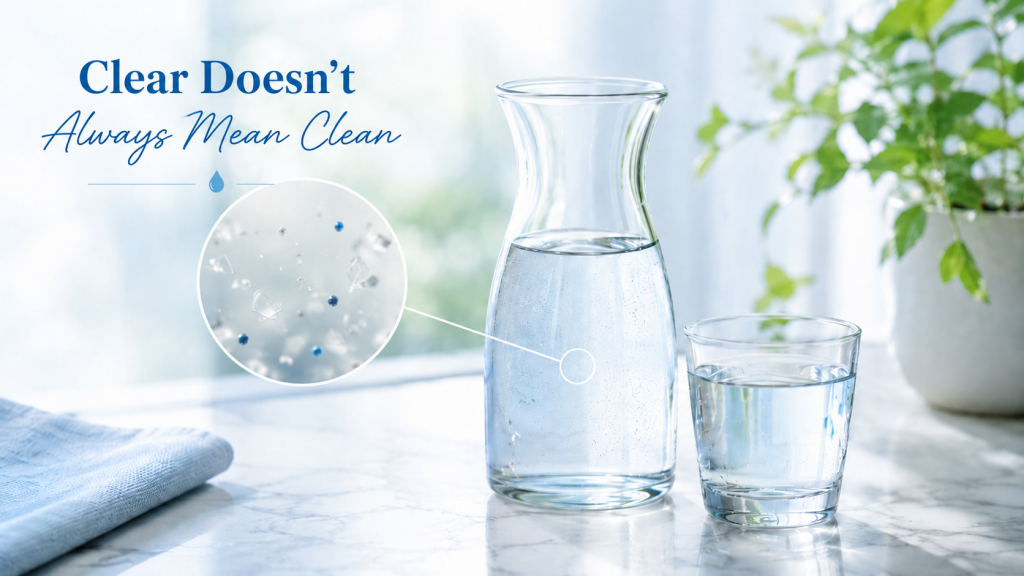
Clear water can still have a story.
And sometimes that story is worth reading.
What Do We Mean by “Water Quality”?
“Water quality” is basically a fancy way of asking:
What’s actually in your water?
That can include minerals, chlorine, lead, PFAS, bacteria, pesticides, sediment, and other substances that may affect taste, smell, appearance, or health.
The EPA sets legal limits for more than 90 contaminants in drinking water, and public water systems are required to follow testing schedules and treatment rules.
That is a good thing.
But it also tells us something important: water can contain things we may not see, smell, or taste. And the fact that there are rules around contaminants means water quality is not just a “crunchy wellness” topic. It is a real-life household topic.
The kind that belongs right next to grocery choices, cleaning products, air quality, and all the other things we slowly start caring about once we realize adulthood is mostly just reading labels and wondering why everything is so complicated.
“Safe” and “Ideal” Are Not Always the Same Thing
This is where things can get a little confusing.
Your tap water may meet legal standards and still have a taste you do not love. It may smell like chlorine. It may leave buildup on your appliances. It may contain trace levels of substances you would rather reduce when possible.
That does not automatically mean your water is unsafe.
But it does mean there is a difference between meets minimum standards and this is the water I feel great drinking every day.
Think of it like food.
A snack can be legally sold in stores and still not be something you want to eat for breakfast, lunch, and dinner. Water works the same way. The question is not always, “Is this allowed?” Sometimes the better question is, “Is this the best option for my home?”
Your Water Can Change Depending on Where You Live
Water quality is not one-size-fits-all.
Your water may come from a river, lake, reservoir, groundwater source, municipal system, or private well. It may travel through miles of pipes before it reaches your kitchen sink. And once it enters your home, your plumbing can also affect what comes out of the faucet.
That means your friend across town may have different water than you do.
Annoying? Yes.
Important? Also yes.
If you use a public water system, your local water supplier is required to provide a Consumer Confidence Report, also known as an annual drinking water quality report. These reports are usually sent each year by July 1 and include information about your local drinking water quality.
That report is a great place to start.
Is it thrilling bedtime reading? Probably not. Unless you are very fun at parties.
But it can tell you what has been detected in your local water and whether anything exceeded federal standards.
Private Wells Need Extra Attention
If your home uses a private well, water quality becomes even more personal.
Private wells are not regulated, treated, or monitored by officials the same way public water systems are. The CDC says private well owners are responsible for making sure their well water is safe to drink.
That does not mean well water is bad.
It means you need to test it.
At minimum, the CDC recommends testing well water once a year for total coliform bacteria, nitrates, total dissolved solids, and pH levels.
So if you have a well and have been operating on “it tastes fine,” this is your gentle nudge. A loving nudge. Not a bossy one. Mostly.
Taste Matters More Than People Admit
Let’s be honest.
If your water tastes weird, you are probably going to drink less of it.
Or you will start buying bottled water.
Or you will live on coffee and hope for the best.
Water quality affects taste, smell, and appearance. Chlorine taste, earthy odors, metallic flavors, cloudiness, and sediment can all make water less appealing.
And while taste is not always a safety issue, it does affect your daily habits.
Cleaner, better-tasting water can make it easier to drink more water, cook with water, make tea, brew coffee, fill reusable bottles, and stop treating hydration like a personal enemy.
Water Quality Affects More Than Drinking
We tend to think about water quality only when we pour a glass.
But water shows up everywhere.
You use it for:
- Coffee and tea
- Soups, pasta, rice, and oatmeal
- Baby formula preparation
- Ice cubes
- Washing produce
- Pets’ water bowls
- Brushing teeth
- Filling reusable bottles
So even if you are not drinking plain water all day, water is still part of your routine.
That means improving your drinking water setup can have a bigger impact than you might think.
The PFAS Conversation Made Water Quality Harder to Ignore
One reason more people are paying attention to water quality is because of PFAS, often called “forever chemicals.”
PFAS are a group of man-made chemicals used in many products over the years, and they can end up in water sources. The EPA finalized the first national legally enforceable drinking water standards for certain PFAS in April 2024.
The CDC notes that researchers are still studying PFAS, but current evidence suggests high levels may be linked to health concerns such as higher cholesterol, changes in liver enzymes, decreased vaccine response in children, pregnancy-related blood pressure concerns, and kidney and testicular cancers.
That does not mean you need to spiral.
It does mean water quality is worth understanding.
Because once contaminants become part of national drinking water conversations, it is a good reminder that “out of sight, out of mind” is not the best water strategy.
A Water Filter Is Not Just a Fancy Kitchen Gadget
This is where water filters come in.
If you’re already thinking about a countertop option, I also put together a simple guide on 5 things to know before buying a countertop water filter so you can compare choices without feeling like you need a chemistry degree.
A good water filter can help reduce certain contaminants, improve taste, and make your daily water feel more trustworthy. But — and this is important — not all water filters do the same thing.
Some filters mainly improve taste and odor.
Some are certified to reduce specific health-related contaminants.
Some handle sediment.
Some reduce lead.
Some reduce certain PFAS.
Some use carbon filtration, reverse osmosis, UV technology, or a combination.
This is why I never love the question, “What’s the best water filter?”
The better question is:
What do you want your water filter to reduce?
NSF explains that common drinking water filter certifications include NSF/ANSI 42 for aesthetic effects like chlorine taste and odor, NSF/ANSI 53 for certain health-related contaminants, and NSF/ANSI 401 for certain emerging compounds or incidental contaminants.
Translation: look beyond the pretty pitcher.
Certification matters.
Claims matter.
Testing matters.
Because a filter can look sleek on your counter and still not do what you actually need it to do. Rude, but true.
This Is Why I’m Getting Picky About Water
The more I learn about water quality, the more I realize this is not something I want to ignore.
I do not want to be dramatic about it. I just want to be informed.
There is a big difference.
I want to know what is in my water. I want to understand what a filter actually reduces. I want better-tasting water without constantly buying plastic bottles. And I want a system that fits real life — because if it is too complicated, expensive to maintain, or annoying to use, let’s be honest, it is going to become a countertop decoration.
A very judgmental countertop decoration.
That is one reason I’ll be talking more about water filters, what to look for, and why I personally like systems that are independently certified for specific contaminant reduction.
For example, eSpring’s current water purifier is listed by Amway as NSF certified to NSF/ANSI Standards 42, 53, 55, and 401, and NSF’s own product listings include eSpring models and replacement elements with certified reduction claims.
I’ll dig into water filters more in a future post, because this topic deserves its own space.
And possibly a strong cup of coffee.
Made with better water, obviously.
So, Where Should You Start?
It’ll help you think through water quality, filtration type, maintenance, size, and long-term value before making a decision.
You do not need to overhaul your entire life today.
Start simple.
First, find your local water quality report if you use city water. Look for what was detected and whether anything stands out.
Second, test your water if you use a private well or have a specific concern, such as lead, PFAS, bacteria, or unusual taste and odor.
Third, learn what different filters actually do before buying one.
Fourth, stop assuming clear water tells the whole story.
Because water quality is not about fear.
It is about paying attention to something you use every single day.
Final Thoughts
Water is easy to overlook because it is always there.
Turn the handle, fill the glass, keep moving.
But once you start paying attention, you realize water quality touches your health, your habits, your food, your home, and your peace of mind.
You do not have to become a water scientist.
You do not need to memorize contaminant names that sound like rejected sci-fi villains.
You just need to get curious.
Because the water your family drinks every day is worth more than a shrug.
And honestly?
So are you.
Sources & Helpful References
This article was researched using publicly available guidance from the following organizations: