
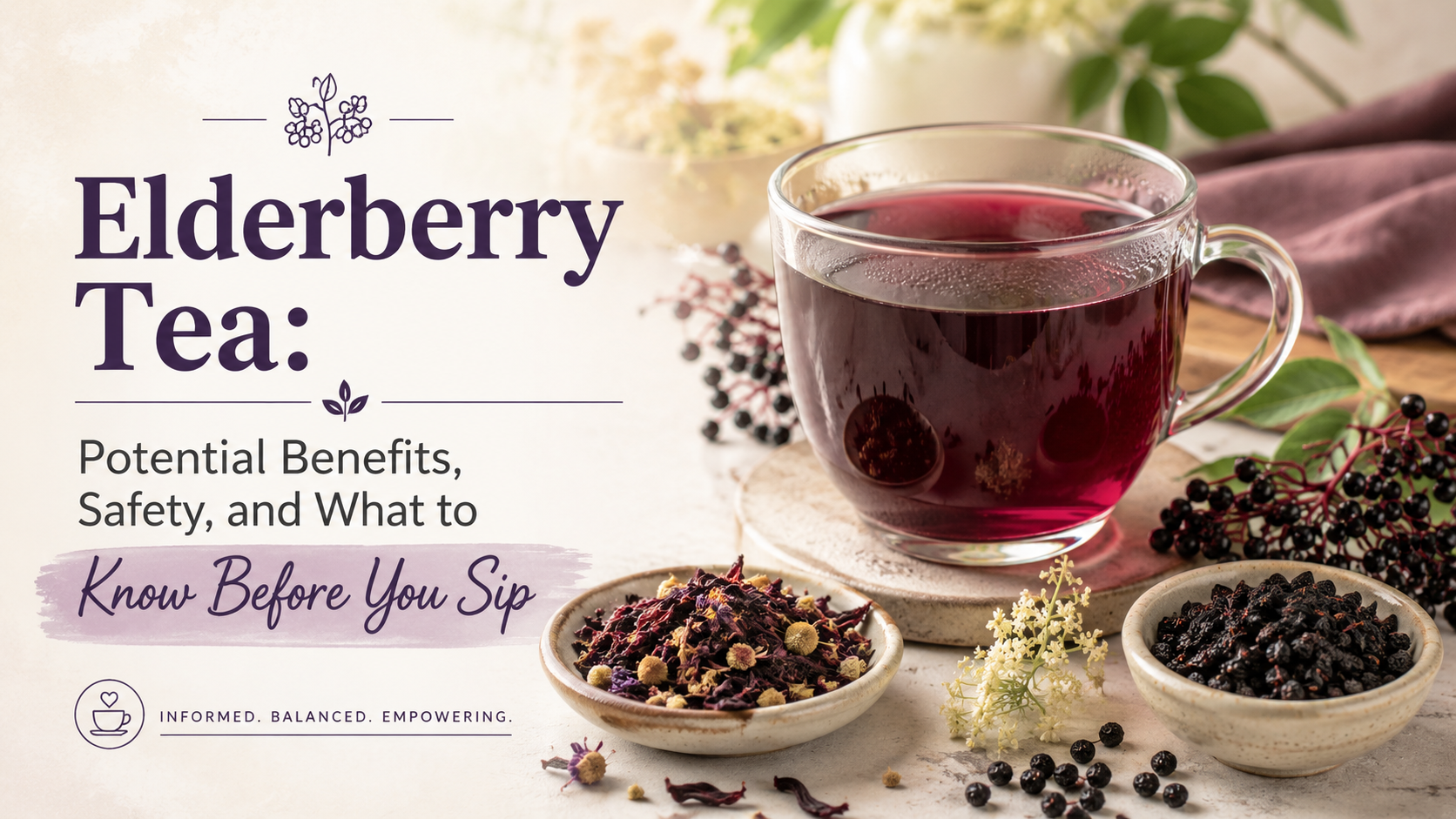
Elderberry Tea: Potential Benefits, Safety, and What to Know Before You Sip
Affiliate disclosure: This post contains affiliate links. If you make a purchase through one of these links, I may earn a commission at no additional cost to you.
Some things in the pantry seem to have their own season.
Pumpkin spice gets fall. Peppermint gets Christmas. And when cold and flu season starts making the rounds, elderberry suddenly finds its way back into the conversation.
I actually have elderberry tea sitting in my own cabinet. I haven’t brewed it in a while, but I originally bought it because, like many people, I had heard so much about elderberry and its connection to seasonal wellness.
And that got me thinking.
Elderberry has been used traditionally for generations, but it has also picked up quite a collection of modern health claims along the way. Some have interesting research behind them. Others are based more on tradition, personal experience, or ideas that are still being studied.
So rather than treating elderberry tea like either a miracle in a mug or something we should dismiss completely, I thought it would be more useful to take a friendly look at the whole picture.
What is elderberry tea? Why do people drink it? What does current research actually tell us? And, just as importantly, is it simply a nice herbal tea to have around?
Let’s take a look.
What Is Elderberry Tea?
Elderberries are the dark purple berries of plants in the Sambucus family. European black elderberry, or Sambucus nigra, is one of the varieties commonly used in commercially prepared elderberry products.
These days, elderberry shows up in all sorts of forms:
Herbal teas
Syrups
Gummies
Lozenges
Capsules
Extracts
But here is something worth knowing: not every elderberry tea is the same.
Some teas may contain elderberry as the main ingredient. Others combine it with herbs, flowers, spices, or fruit such as hibiscus, rose hips, echinacea, apple, or lemongrass.
That matters when we start talking about research.
A cup of herbal tea containing some elderberry is not necessarily the same thing as the concentrated elderberry extracts or syrups researchers may use in a study.
It sounds like a small distinction, but it is an important one.
Why Has Elderberry Been Used Traditionally?
Elderberry has a long history in traditional wellness practices, especially during the colder months and when people were dealing with respiratory discomfort.
That history is part of the reason elderberry remains so popular today.
Traditional practices can tell us a great deal about how people have used foods, herbs, and plants over generations. They can also give researchers interesting questions to investigate.
At the same time, traditional use and modern scientific evidence answer somewhat different questions.
Something can have a long history of traditional use without every claimed benefit having been proven in clinical studies.
I don’t think we need to choose one perspective and throw out the other.
We can respect what generations before us observed while also being curious about what modern research is finding.
What Does Research Say About Elderberry?
Researchers have looked at certain elderberry preparations for their possible effects on colds, flu, and other upper-respiratory symptoms.
The National Center for Complementary and Integrative Health reports that some preliminary research suggests certain elderberry preparations may help with respiratory symptoms, but the research is still limited.
So there is some reason for continued interest—but we do not have all the answers yet.
And there is another important piece of the puzzle.
Many of these studies have used specific elderberry extracts, syrups, capsules, or other concentrated preparations.
They have not necessarily studied the cup of elderberry tea sitting on your kitchen counter.
That means we should be careful about assuming that every elderberry product will have the same effects.
A Simple Way to Look at It
Traditional wellness: Elderberry has long been used during cold and flu season.
Current research: Some elderberry preparations have shown promising results for certain upper-respiratory symptoms.
What we still don’t know: Whether an ordinary cup of elderberry tea produces those same effects.
I think that is a much more useful answer than either “elderberry cures everything” or “there is nothing to it.”
Does Elderberry Tea “Boost” Your Immune System?
This is probably one of the most common claims you will see about elderberry.
Elderberries contain naturally occurring plant compounds, including anthocyanins and other polyphenols. These compounds have antioxidant activity, and researchers continue to study elderberry in relation to immune and respiratory health.
But the phrase “boost your immune system” can make things sound much simpler than they really are.
Our immune systems are complicated. They are not switches that flip from low to high because we drank one particular tea.
So instead of saying elderberry tea “boosts immunity,” I think a fairer way to describe it is this:
Elderberry has a long traditional connection to seasonal and immune wellness, and researchers continue to study its possible effects.
It is a little less flashy.
It is also a lot more useful.
Can Elderberry Tea Prevent a Cold or the Flu?
There is not enough reliable evidence to say that drinking elderberry tea will prevent you from catching a cold or the flu.
But that does not mean a cup of elderberry tea has no place when you are feeling under the weather.
A warm tea gives you fluid. It can be soothing. It encourages you to sit down for a few minutes and take care of yourself.
Sometimes that simple ritual is valuable all by itself.
Tea does not have to cure anything to earn its place in the cabinet.
What About Elderberry’s Other Reported Benefits?
If you spend much time reading about elderberry, you will probably run into a much longer list of possible benefits.
You may see it associated with:
Inflammation
Joint comfort
Digestion
Skin health
Blood pressure
Cholesterol
Respiratory health
Mood
Some of these ideas come from traditional use. Others come from laboratory research, early studies, or personal experiences.
At this point, however, there is not enough reliable research in people to say that drinking elderberry tea can be expected to treat or improve these conditions.
That does not mean researchers will never learn more.
It simply means I would rather tell you where the evidence stands today than make a promise the research cannot yet support.
Is Elderberry Tea Safe?
This part is important, especially if you have ever thought about gathering elderberries yourself.
Commercially prepared elderberry tea is very different from picking berries, leaves, or stems from an elder plant and putting them straight into your teapot.
Raw or unripe elderberries, along with parts of the plant such as leaves and stems, can contain compounds that may release cyanide in the body. Improper preparation can cause nausea, vomiting, diarrhea, and potentially more serious problems.
That is one reason I would stick with properly prepared elderberry products from a reputable source rather than experimenting with unidentified plant material at home.
It is also a good idea to speak with a healthcare professional before using elderberry regularly for a specific health purpose if you:
Are pregnant or breastfeeding
Take prescription medications
Have a chronic health condition
Are considering elderberry instead of recommended medical care
Herbs may be natural, but “natural” does not automatically mean appropriate for every person or situation.
What’s Actually in Your Elderberry Tea?
This is where reading the ingredient list becomes interesting.
The words “elderberry tea” can make it sound like you are buying a bag filled with nothing but elderberries.
That is often not the case.
Many elderberry teas are actually blends.
One example is Adagio Elderberry Wine, a naturally caffeine-free herbal blend containing elderberry along with hibiscus, rose hips, apple pieces, echinacea, lemongrass, raspberries, and blue cornflowers.
And despite the name, no—you are not pouring wine into your teacup. It is an herbal tea blend with a fruity flavor profile.
Explore Adagio Elderberry Wine
This is also why I recommend checking the full ingredient list when trying any herbal tea. Two boxes that both say “elderberry” on the front may contain very different blends inside.
What Does Elderberry Tea Taste Like?
This will depend quite a bit on what else is in the blend.
Elderberry is generally associated with a deep, tart berry flavor.
When combined with ingredients such as hibiscus, raspberries, rose hips, or apple, it can become fruity, tangy, and sometimes naturally sweet-tasting.
Adagio’s Elderberry Wine blend, for example, is designed around grape- and cranberry-like flavors.
Because it is caffeine-free, a tea like this can also be nice when you want something warm later in the day without adding another cup of coffee or caffeinated tea.
And sometimes that is reason enough to keep a tea around.
How to Enjoy Elderberry Tea
One nice thing about herbal tea is that there really is no need to make it complicated.
Start by trying your tea plain so you can see what you think of the flavor.
Then, if you want to change things up, you might try:
A little honey
A slice of lemon
Fresh ginger
A cinnamon stick
Frozen berries for an iced version
And yes, elderberry tea can absolutely be enjoyed cold.
Herbal tea does not have to wait for scarves, fireplaces, and cold noses before it is allowed out of the cupboard.
Is Elderberry Tea Worth Trying?
I think that depends on what you are expecting from it.
If you are looking for a miracle drink that promises to keep every cold away, elderberry tea cannot honestly make that promise.
But if you enjoy fruity herbal teas and like learning about foods and herbs with an interesting traditional history, elderberry can certainly be worth exploring.
Its long-standing use in traditional wellness is fascinating. Some research involving specific elderberry preparations is promising enough to keep scientists interested. And there is still plenty we have to learn.
For me, that is part of what makes food and wellness so interesting.
We do not always have to have a final answer before we can learn something useful.
And as for that elderberry tea sitting in my cabinet?
I think I may finally brew myself another cup.
The Bottom Line
Elderberry lives in that interesting space where traditional wellness and modern research meet.
People have used elderberry for generations, particularly during cold and flu season. Modern researchers have found some promising results involving certain elderberry preparations and upper-respiratory symptoms, but the evidence is still developing—and those findings cannot automatically be applied to every cup of elderberry tea.
That does not mean we have to dismiss elderberry.
And it does not mean we have to turn it into a miracle remedy either.
We can appreciate its history, stay curious about the research, choose properly prepared products, and enjoy a cup of tea simply because we like it.
For me, that feels like a much healthier way to approach wellness:
Learn what we can. Stay curious. And make one thoughtful choice at a time.
Health note: This information is provided for educational purposes and is not a substitute for personalized medical advice. Because everyone’s health needs are different, consider discussing significant changes or concerns with a qualified healthcare professional who understands your individual situation.