
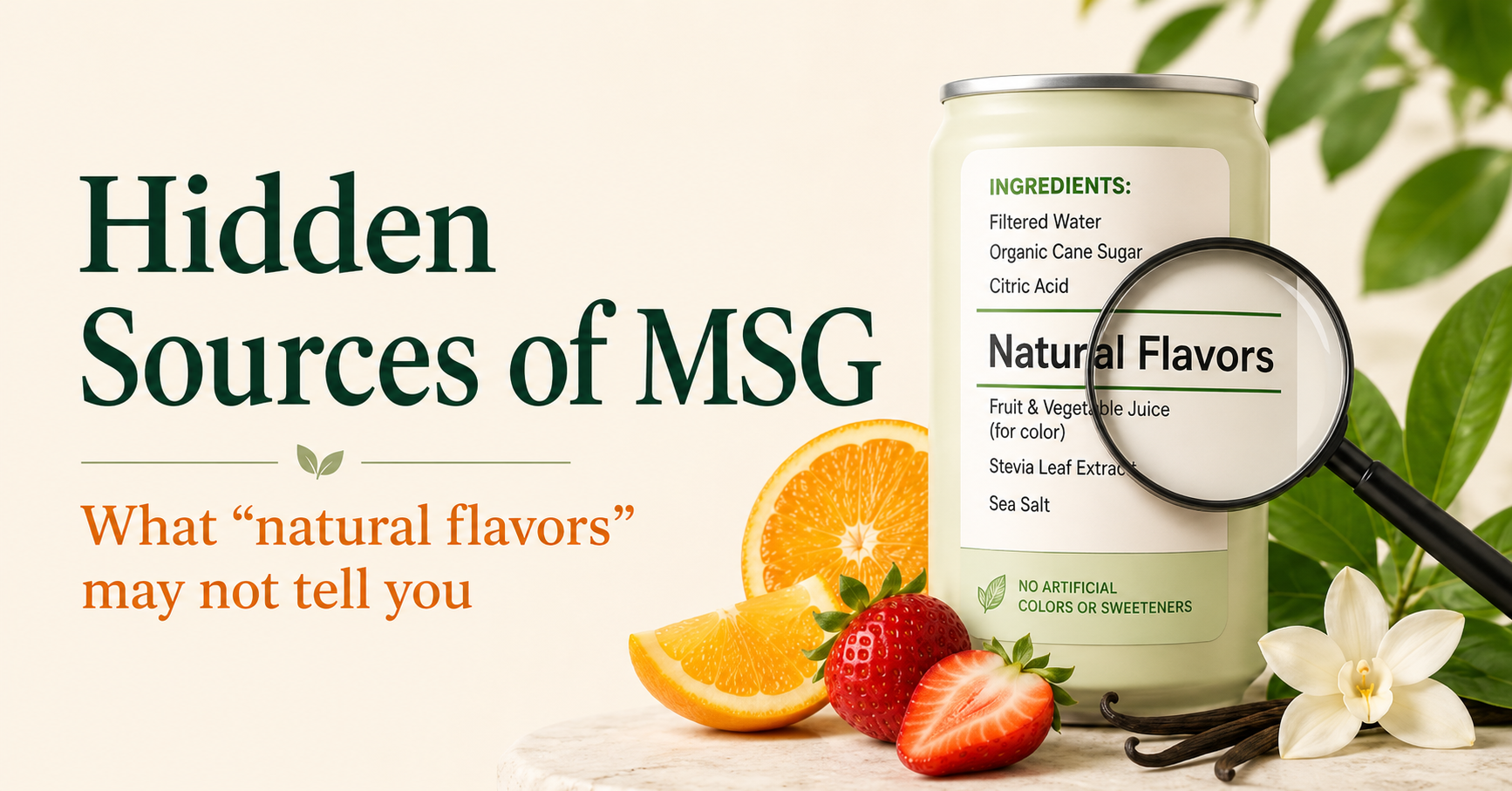
Have you ever eaten something labeled “natural,” “healthy,” or “clean” and then wondered why you suddenly felt off?
Maybe it was brain fog. Maybe fatigue. Maybe anxiety. Maybe a headache. Or maybe it was that strange, hard-to-explain feeling of, “Why do I suddenly need a nap, a snack, and a full life reset?”
One possible culprit for some people is MSG, also known as monosodium glutamate.
Most of us think of MSG as something found in fast food, takeout, or salty snack foods. But potential hidden sources of MSG can show up in far more places than people realize, including foods marketed as healthy.
Protein bars. Nut milks. Broths. Seasonings. Sauces. Herbal teas. Supplements. “Natural” packaged foods.
Yep. The wellness aisle is not always as innocent as it looks.
This does not mean every product with “natural flavors” contains added MSG. But it does mean that if you are sensitive to MSG or glutamate-based ingredients, it is worth learning how to read labels with a little more curiosity and a little less blind trust — even when buying organic foods.
Because “natural” on a label does not automatically mean “good for your body.”
Rude, but true.
What Is MSG?
MSG stands for monosodium glutamate. It is the sodium salt of glutamic acid, an amino acid that naturally occurs in the body and in foods like tomatoes, cheeses, mushrooms, and seaweed.
MSG is used to make food taste more savory, rich, and satisfying. It enhances flavor, especially that deep umami taste that makes foods more craveable.
The FDA considers added MSG to be “generally recognized as safe.” However, the FDA also acknowledges that some people identify themselves as sensitive to MSG, even though studies have not consistently confirmed reactions in those individuals. Reports have included symptoms such as headache, nausea, flushing, tingling, palpitations, drowsiness, and similar short-term symptoms in some sensitive people.
So the issue is not necessarily that everyone needs to panic over MSG.
The issue is that some people may not tolerate it well, and many people do not realize how often glutamate-based or flavor-enhancing ingredients can appear in packaged foods.
And that is where food labels can get a little sneaky.
Why MSG Can Be Confusing on Food Labels
If MSG is added directly to a food, it has to be listed as monosodium glutamate on the ingredient label.
That part is straightforward.
But here’s where things get more complicated: MSG can also occur naturally in certain ingredients, including hydrolyzed vegetable protein, autolyzed yeast, hydrolyzed yeast, yeast extract, soy extracts, and protein isolate. These ingredients have to be listed on the label, but the label does not have to separately say they naturally contain MSG.
That is why people often talk about “hidden MSG.”
It is not always that companies are secretly dumping MSG into a product and refusing to list it. The bigger concern is that certain ingredients may contain free glutamates or MSG-like flavor-enhancing compounds, and the average shopper may not recognize them.
So instead of saying:
Natural flavors are always MSG.
A more accurate way to say it is:
Natural flavors do not always mean MSG, but some flavor-enhancing ingredients can make it harder to know exactly what you are eating, especially if you are sensitive to MSG or free glutamates.
That distinction matters.
It keeps us honest, informed, and much harder to dismiss.
Is MSG Hiding in Natural Flavors?
This is one of the biggest questions people have.
The short answer: not always.
The better answer: natural flavors can be vague, and that vagueness is the problem.
“Natural flavors” sounds harmless. It sounds like someone squeezed a strawberry into your protein bar while wearing linen and listening to birdsong.
But natural flavors are created to enhance taste. They can come from plant or animal sources, and the label usually does not tell you exactly what is inside that flavor blend.
That lack of detail can be frustrating if you are trying to avoid certain ingredients, especially if you are sensitive to MSG, glutamates, allergens, or additives.
So while I would not say every product with natural flavors contains MSG, I would say this:
If you are sensitive to MSG or free glutamates, natural flavors are worth paying attention to.
Not panicking over.
Paying attention to.
Big difference.
My Take on Natural Flavors
Personally, I don’t lose sleep over natural flavors.
But I also don’t automatically assume a product is healthy just because the word “natural” is hanging out on the label looking innocent.
If I see natural flavors on a product I’m considering buying, and there aren’t many better options available, I may contact the company directly and ask what those natural flavors are derived from. I prefer knowing as much as possible about what’s in my food instead of relying on marketing terms that sound pretty but don’t tell me much.
When I’m grocery shopping, I try to focus on foods with simple, recognizable ingredients whenever possible. The fewer mysteries on the ingredient list, the better.
Natural flavors aren’t necessarily the villain of the food world. They’re more like a reminder that food labels are often designed to sell products — not educate consumers.
And that’s exactly why it’s worth learning what those little words really mean.
Common Hidden Sources of MSG to Watch For
If you are sensitive to MSG or trying to reduce glutamate-based additives, these are some ingredients worth watching for on food labels:
- Monosodium glutamate
- Hydrolyzed vegetable protein
- Hydrolyzed plant protein
- Hydrolyzed protein
- Autolyzed yeast
- Yeast extract
- Hydrolyzed yeast
- Soy extract
- Soy protein isolate
- Protein isolate
- Textured protein
- Natural flavors
- Natural flavoring
- Flavoring
- Seasoning blends
- Bouillon
- Broth concentrates
- Stock powders
- Savory flavor blends
Now, a little nuance because we are being smart here:
Not every one of these automatically means “added MSG.”
But many of them may indicate the presence of free glutamates, flavor enhancers, or ingredients that can affect people who are sensitive.
That means these ingredients belong on your “pause and investigate” list.
Not your “panic and throw the whole pantry into the yard” list.
Although we have all had those moments.
Why “Healthy” Foods Can Still Be a Problem
One of the most frustrating parts of learning to read food labels is realizing that “healthy-looking” products are not always as clean as they seem.
You may find vague flavor-enhancing ingredients in foods like:
- Protein bars
- Protein powders
- Plant-based meats
- Nut milks
- Dairy-free creamers
- Flavored yogurts
- Broths and soups
- Salad dressings
- Seasoning blends
- Crackers and chips
- Frozen meals
- “Natural” snacks
- Supplements
- Herbal drink mixes
- Low-calorie packaged foods
This does not mean every product in these categories is bad.
It means the front of the package is marketing.
The back of the package is where the truth lives.
And she is usually in tiny font.
Possible Symptoms Some People Connect to MSG Sensitivity
Some people report feeling poorly after eating MSG or glutamate-rich additives.
Reported symptoms may include:
- Headaches
- Brain fog
- Fatigue
- Anxiety
- Flushing
- Nausea
- Tingling
- Drowsiness
- Heart palpitations
- Mood changes
- Restlessness
Of course, these symptoms can have many possible causes. Stress, blood sugar swings, dehydration, food sensitivities, poor sleep, hormones, caffeine, and approximately 47 other things can all play a role.
That is why it is important not to self-diagnose based on one ingredient alone.
But if you notice a pattern after eating certain packaged foods, it may be worth tracking.
A simple food journal can be surprisingly revealing. Write down what you ate, the ingredients you noticed, and how you felt afterward. Over time, patterns may start waving at you like, “Hello, it’s me. I’m the problem.”
How to Read Labels for Hidden Sources of MSG
Reading food labels does not have to be overwhelming. You do not need a chemistry degree, a magnifying glass, and a dramatic soundtrack.
Start with these simple steps.
1. Look for obvious MSG
Check the ingredient list for:
Monosodium glutamate
If MSG was added directly to the product, this is how it should appear.
2. Watch for glutamate-rich ingredients
Pay close attention to ingredients like:
Yeast extract, autolyzed yeast, hydrolyzed protein, hydrolyzed vegetable protein, soy protein isolate, protein isolate, and soy extract.
These are ingredients the FDA identifies as examples where MSG can naturally occur.
3. Be cautious with vague flavor terms
Ingredients like “natural flavors,” “flavoring,” and “seasoning” may not tell you enough.
They do not automatically mean MSG, but they may deserve extra attention if you are sensitive.
4. Do not assume “healthy” means clean
Words like these can be useful, but they do not tell the whole story:
- Natural
- Organic
- Plant-based
- Gluten-free
- Vegan
- Non-GMO
- Keto
- Paleo
- High-protein
- No artificial flavors
A product can have a beautiful label and still contain ingredients that do not work well for your body.
Marketing is powerful.
So is reading the back of the package.
5. Choose simpler ingredient lists when possible
A good rule of thumb:
The shorter and clearer the ingredient list, the easier it is to know what you are eating.
Not perfect.
But helpful.
Want Help Planning Simpler, Cleaner Meals?
Once you start paying closer attention to food labels, it can feel a little overwhelming to figure out what to eat instead.
That is where my Organic Meal Planner GPT can help.
It is designed to help you plan simple, organic meals, create grocery lists, and come up with healthier food ideas using more recognizable ingredients.
Try the Organic Meal Planner GPT
It is not a medical tool or a food-sensitivity diagnosis tool, but it can help make cleaner meal planning feel less complicated — and that is a pretty good place to start.
What to Eat Instead
Trying to avoid hidden sources of MSG does not mean you have to live on plain lettuce and sadness.
Flavor is still allowed.
Joy is still allowed.
Seasoning your food is still very much allowed.
The goal is to focus on simple, recognizable ingredients whenever possible.
Some good options include:
- Fresh fruits
- Fresh vegetables
- Plain meats
- Eggs
- Beans and lentils, if tolerated
- Whole grains
- Plain nuts and seeds
- Homemade broths
- Simple salad dressings
- Herbs and spices
- Lemon juice
- Garlic
- Onion
- Sea salt
- Apple cider vinegar
- Fresh ginger
- Homemade sauces
The goal is not perfection.
The goal is awareness.
Because once you understand what certain ingredients mean, you can make better choices without feeling overwhelmed.
This Is Not About Fear. It Is About Awareness.
The point of learning about hidden sources of MSG is not to be afraid of every food label.
The point is to become more informed.
When you know what to look for, you can make choices that better support your energy, mood, digestion, brain function, and overall healing.
You do not have to believe every marketing claim.
You do not have to buy something just because the package looks earthy and wholesome.
You do not have to assume “natural” means safe, healthy, or right for your body.
You get to ask better questions.
You get to read the label.
You get to decide what belongs in your cart.
And that is powerful.
Knowledge is power.
Awareness is healing.
And food labels?
Well, they are often tiny little puzzles wrapped in branding.
But now you know how to start solving them.
FAQ: Hidden Sources of MSG
What are hidden sources of MSG?
Hidden sources of MSG are ingredients that may contain MSG, free glutamates, or glutamate-based flavor enhancers without the label saying “MSG” directly. Examples include yeast extract, autolyzed yeast, hydrolyzed vegetable protein, hydrolyzed protein, soy extracts, and protein isolate.
Can MSG be listed as natural flavors?
Added MSG must be listed as monosodium glutamate on the ingredient label. However, natural flavors can still be vague, and some flavor-enhancing ingredients may contain free glutamates. So while natural flavors do not always mean MSG, people who are sensitive may want to be cautious.
Is yeast extract the same as MSG?
Yeast extract is not exactly the same as added MSG, but it can naturally contain glutamate. That is why some people who are sensitive to MSG also choose to avoid yeast extract.
Is hydrolyzed vegetable protein a source of MSG?
Hydrolyzed vegetable protein can naturally contain MSG or free glutamates. The FDA lists hydrolyzed vegetable protein as one of the ingredients where MSG can naturally occur.
Can MSG cause brain fog or anxiety?
Some people report symptoms like brain fog, anxiety, headaches, fatigue, or mood changes after consuming MSG or glutamate-rich additives. Research does not confirm that MSG causes these symptoms in everyone, but sensitive individuals may choose to track their food intake and symptoms to look for patterns.
How can I avoid hidden sources of MSG?
The easiest way to avoid hidden sources of MSG is to read ingredient labels carefully, choose foods with simple ingredients, avoid products with yeast extract or hydrolyzed proteins if you are sensitive, and be cautious with vague terms like natural flavors, flavoring, and seasoning blends.
Are all natural flavors bad?
No. Natural flavors are not automatically bad. The issue is that the term is vague. If you are sensitive to certain ingredients or trying to eat cleaner, it is worth paying attention to products that use vague flavoring terms instead of clearly listing what is inside.
Should I throw away every food that contains natural flavors?
Not necessarily. Natural flavors do not bother everyone, and they are not always a problem. A more balanced approach is to notice how your body responds, choose simpler foods when possible, and contact companies directly when you want more information about a product.
Want a Simpler Way to Start Eating Cleaner?
Learning about hidden sources of MSG is a great first step, but the next question is usually:
“Okay… so what do I eat now?”
That is exactly why I created my clean eating guide.
It is designed to help you make healthier food choices, simplify your meals, and feel more confident about what you are putting into your body — without making clean eating feel complicated or overwhelming.
Because eating better should feel doable, not like a second job.