
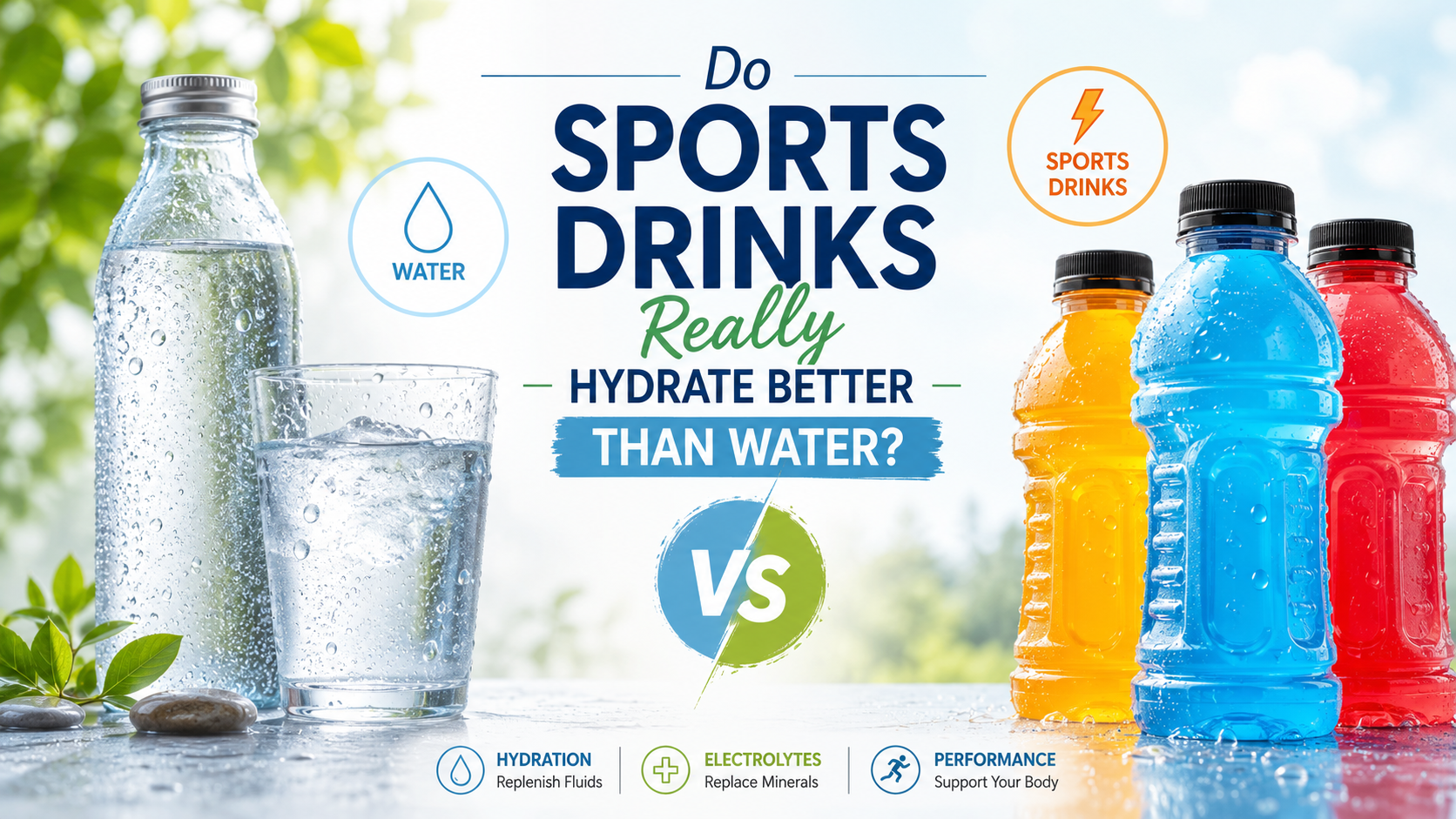
Do Sports Drinks Really Hydrate Better Than Water?
Walk through the beverage aisle and it is easy to get the impression that plain water has fallen hopelessly behind.
Sports drinks come in bright colors, promise electrolytes and hydration, and often feature athletes who look as though they have just completed something far more ambitious than my average afternoon.
But do sports drinks really hydrate you better than water?
The answer is sometimes.
For everyday hydration and many shorter or moderate workouts, plain water generally does the job quite well. Sports drinks can become more useful when exercise is prolonged, intense, performed in hot conditions, or involves enough sweating that you are losing meaningful amounts of fluid and electrolytes, according to the American College of Sports Medicine (ACSM).
So this is not really a contest where one drink has to be declared the winner.
It is more about matching the drink to what your body is actually doing.
What Is a Sports Drink Supposed to Do?
Traditional sports drinks are designed to provide three main things:
Fluid
Electrolytes
Carbohydrates
Water replaces fluid. Electrolytes—especially sodium—help replace minerals lost through sweat. Carbohydrates provide fuel that may become useful during longer periods of exercise. Sports beverages are therefore intended for a different situation than simply being thirsty while going about an ordinary day. The American College of Sports Medicine discusses the role hydration and electrolytes can play during exercise.
That distinction gets lost surprisingly often.
A drink designed for someone running for an hour in the heat may not offer much advantage to someone answering email at the kitchen table.
The same bottle can make sense in one situation and be unnecessary in another.
What Are Electrolytes, Anyway?
Electrolytes are minerals that carry an electrical charge and help the body with functions including fluid balance, nerve signaling, and muscle activity.
Some of the electrolytes you may see in sports drinks include:
Sodium
Potassium
Chloride
Calcium
Magnesium
Sweat contains both water and electrolytes, particularly sodium. The amount you lose varies according to factors such as exercise intensity, duration, temperature, humidity, and how heavily you personally sweat. The American College of Sports Medicine provides additional information about hydration and electrolyte needs.
Most of us also get electrolytes through ordinary food.
That means seeing the word electrolytes on a bottle does not automatically mean your body is short on them.
When Might a Sports Drink Be Helpful?
A sports drink may make sense when you are:
Exercising hard for an extended period
Participating in endurance activities
Sweating heavily for a long time
Exercising or working in hot or humid conditions
Trying to replace both carbohydrates and electrolytes during prolonged physical activity
For shorter exercise sessions, water is often sufficient. The American College of Sports Medicine notes that water is generally appropriate for exercise lasting less than about an hour, while sports drinks may become more useful during longer endurance exercise, particularly with substantial sweating.
There is no magical moment at exactly 60 minutes when your water bottle suddenly becomes inadequate, of course.
Your needs depend on the activity, weather, sweat rate, intensity, and individual circumstances.
What About People Who Work Outdoors in Extreme Heat?
Athletes are not the only people who may lose large amounts of fluid and electrolytes through sweat.
Think about roofers, landscapers, construction crews, road workers, agricultural workers, and others who spend hours doing physical labor outdoors—especially during extremely hot weather.
For shorter periods of moderate work in the heat, water is usually the starting point. But when someone is working and sweating for several hours, replacing electrolytes may become important too. The National Institute for Occupational Safety and Health (NIOSH) recommends water at regular intervals during heat exposure and suggests balanced electrolyte drinks when sweating continues for several hours. The Occupational Safety and Health Administration (OSHA) also recommends electrolyte-containing beverages for longer jobs in the heat.
That does not mean workers should simply drink unlimited sports drinks. Hydration is only one part of heat safety. Rest breaks, shade or cooling, acclimatization, and reducing heat exposure are also important protections against heat-related illness.
So when we talk about sports drinks being useful during prolonged sweating, we should not picture only marathon runners.
Sometimes the person who may benefit from electrolyte replacement is the one laying shingles on a roof, pouring asphalt, or maintaining a landscape in the middle of summer.
That is a very different situation from drinking a sports drink simply because you are thirsty while sitting at your desk.
Do Sports Drinks Hydrate Better Than Water?
Under some circumstances, they can offer advantages.
Electrolytes and carbohydrates can help support fluid replacement and provide fuel during prolonged activity. Carbohydrates can also aid fluid absorption, which is one reason sports beverages were developed for endurance activity rather than ordinary thirst.
But that does not mean a sports drink is automatically a superior choice every time you need something to drink.
For everyday hydration, water remains simple, calorie-free, inexpensive, and effective. The Centers for Disease Control and Prevention (CDC) continues to recommend water as an everyday beverage choice.
Sometimes the humble answer really is just water.
What’s Actually in a Sports Drink?
This is where things get more interesting.
Turn the bottle around and you may find much more than water and electrolytes.
Depending on the product, the ingredient list may include:
Added sugars
Natural or artificial flavors
Color additives
Preservatives
Acids
Artificial or low-calorie sweeteners
Added vitamins
Several different mineral compounds
That does not automatically make the beverage unhealthy or inappropriate.
Ingredients are added for different reasons. Some provide fuel or electrolytes. Others influence flavor, appearance, acidity, sweetness, stability, or shelf life. The U.S. Food and Drug Administration (FDA) explains that food ingredients and additives can serve a variety of purposes, including flavoring, coloring, preservation, and maintaining product quality.
So instead of looking at a long ingredient list and immediately thinking, Oh no, chemistry, I prefer a more useful question:
What is each ingredient doing here, and does this particular drink make sense for what I need?
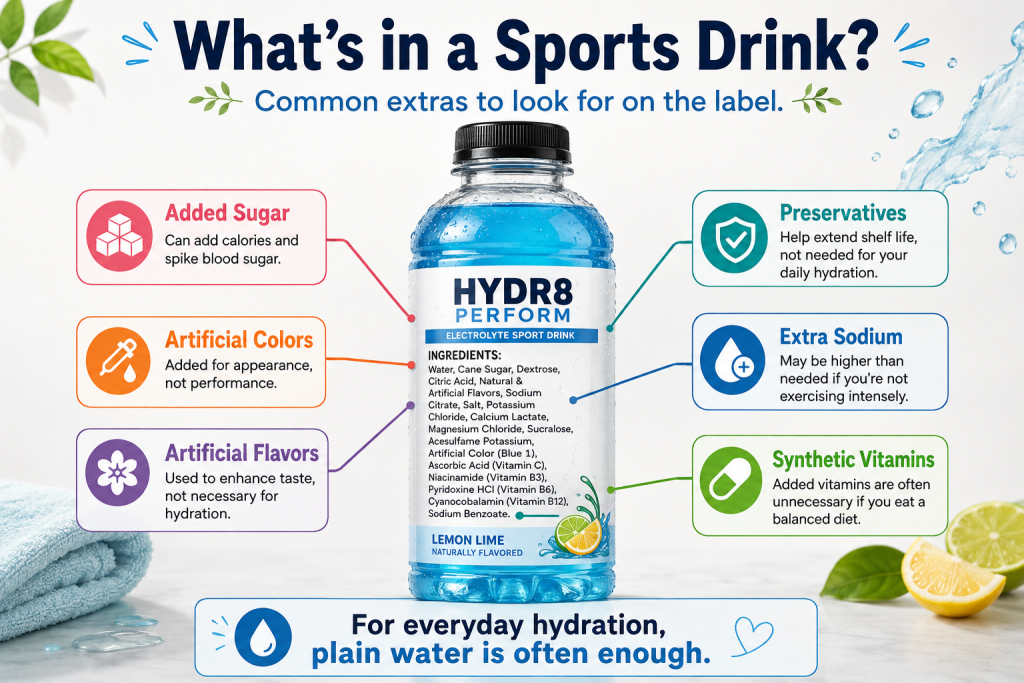
The graphic gives you a quick overview. Now let’s decode some of the terms you may see on an actual bottle.
Sports Drink Label Glossary
Electrolytes
Electrolytes are electrically charged minerals involved in fluid balance, nerve signaling, and normal muscle function.
In sports drinks, the most noticeable one is usually sodium, although potassium, chloride, magnesium, or calcium may also appear.
Electrolytes can be useful when you have lost meaningful amounts through prolonged sweating. They are not something every person needs to deliberately add to every glass of water.
Sodium
Sodium is an electrolyte and one of the primary minerals lost through sweat.
That is why sodium in a sports drink is not necessarily an ingredient we should automatically label as “bad.”
During prolonged or heavy sweating, replacing sodium may be useful. During an ordinary day with little physical activity, you may not need a specialized drink to provide more of it.
Check the Nutrition Facts panel rather than assuming all sports drinks contain similar amounts.
Potassium
Potassium is another electrolyte involved in fluid balance and normal nerve and muscle function.
On an ingredient list, you might see it in a form such as potassium chloride or potassium citrate.
Again, the presence of potassium does not automatically make one bottle “healthier” than another. It tells you something about how the beverage has been formulated.
Carbohydrates
Carbohydrates provide energy.
Traditional sports drinks often contain carbohydrates because people engaged in long or strenuous exercise may benefit from additional fuel during activity.
If you are taking a leisurely walk around the neighborhood, you probably have a very different fueling requirement from someone two hours into an endurance event.
Context matters.
Added Sugars
Sports drinks may contain sugars such as:
Cane sugar
Dextrose
Glucose
Sucrose
Fructose
Corn syrup
The U.S. Food and Drug Administration defines added sugars as sugars added during processing, as well as certain syrups, honey, and concentrated fruit or vegetable juices used as sweeteners. The Nutrition Facts panel lists added sugars separately so you can see how much a product provides per serving.
Sugar in a sports drink is not always there simply to make the beverage taste good. During prolonged physical activity, carbohydrate can provide useful fuel.
But if you are drinking the same beverage as an everyday thirst quencher, those added sugars may be supplying calories and carbohydrates you were not really looking for.
That is why I would rather ask “Do I need this right now?” than automatically classify sugar in a sports beverage as good or bad.
Dextrose
Dextrose is a simple sugar that is chemically the same as glucose.
If you see it on the ingredient list, it is primarily contributing carbohydrate and sweetness.
Its presence makes more sense when a beverage is intended to provide quick carbohydrate during activity than when the drink is being used simply because you wanted something cold.
Citric Acid
Citric acid contributes tartness and helps control acidity.
It appears in many beverages and packaged foods and does not necessarily mean the product contains a meaningful amount of citrus fruit. The Food and Drug Administration lists acids among ingredients used for purposes including flavor and acidity control.
Natural Flavors
Here is one ingredient that deserves a little extra conversation.
Natural flavors are used primarily to add or enhance flavor. The term can cover flavoring substances derived from natural sources, but the words natural flavors on a label usually do not tell the consumer every component of the flavor system.
That does not mean natural flavors are automatically harmful.
And it does not mean natural flavors automatically contain monosodium glutamate (MSG).
But the phrase can be frustrating if you are someone who wants to know exactly what is in a packaged food or beverage.
I explored that issue more deeply in Hidden Sources of MSG: What to Watch for on “Natural” Food Labels.
In that article, I explain why natural flavors should not automatically be treated as MSG, while also looking at why vague flavoring terms can deserve a little more attention if you are sensitive to MSG, free glutamates, or particular food additives.
The goal is awareness—not panic.
That same approach works here.
You do not have to fear the phrase natural flavors.
You simply deserve to understand what the label is—and is not—telling you.
Artificial Flavors
Artificial flavors are used to create or enhance flavor but do not meet the regulatory definition of natural flavor.
They are there primarily for taste.
They do not replace electrolytes or make a drink inherently more hydrating.
At the same time, taste can influence what people are willing to drink, so flavor itself is not necessarily a pointless part of a sports beverage.
Color Additives
Sports drinks are not exactly known for their subtle color palette.
Color additives may be used to enhance color, create a particular appearance, or help consumers associate a color with a flavor. The Food and Drug Administration notes, for example, that colors can help identify flavors such as yellow for lemon or purple for grape.
The color itself does not improve hydration.
That bright electric blue may make the bottle easy to spot from across the gym, but your muscles are not requesting Blue No. 1 after a workout.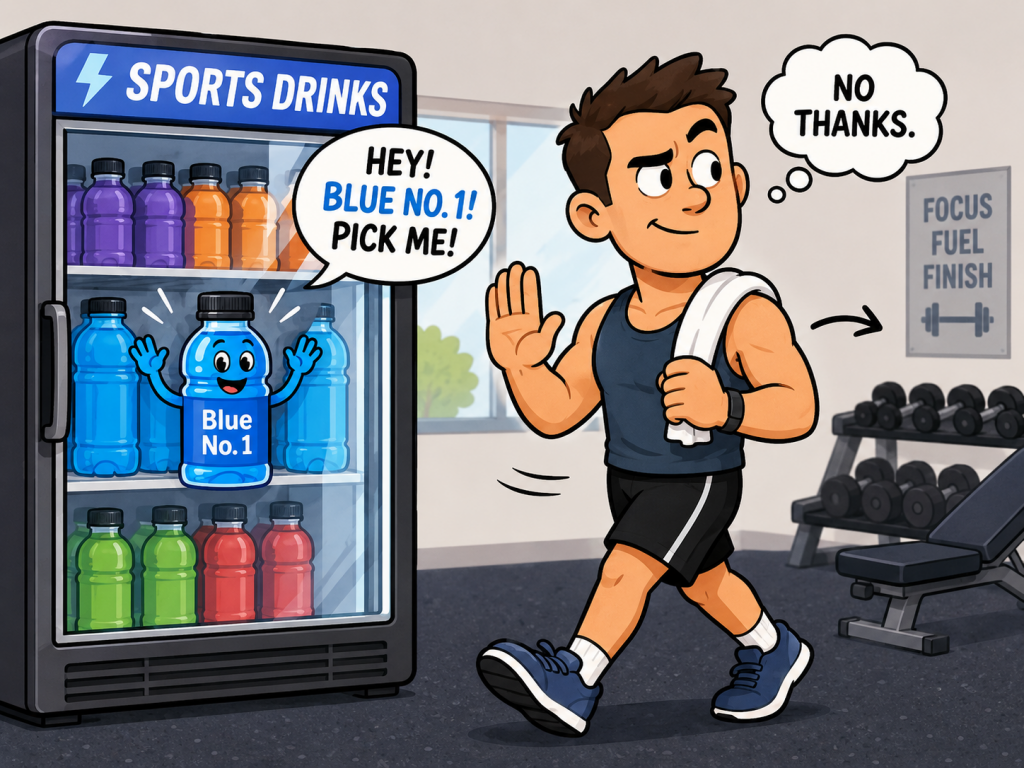
Preservatives
Preservatives help protect foods and beverages from deterioration and extend shelf life.
Depending on the formulation, a sports drink may contain ingredients such as sodium benzoate or potassium sorbate for preservation purposes. The Food and Drug Administration recognizes preservatives as ingredients used to help prevent spoilage and maintain food quality.
Preservatives are not there because your body needs them after exercise.
They are there because the product needs to remain stable while it sits in a bottle.
Those are two very different jobs.
Sodium Benzoate
Sodium benzoate is a preservative used in some acidic foods and beverages.
If you see it on a sports-drink label, its role is preservation rather than hydration.
That does not automatically tell you whether the overall drink is a good or poor choice. It simply tells you what that particular ingredient is doing.
Artificial or Low-Calorie Sweeteners
Some low-sugar or sugar-free sports beverages use sweeteners such as:
Sucralose
Acesulfame potassium
Stevia-derived sweeteners
These provide sweetness with little or no added sugar.
A sugar-free electrolyte beverage may appeal to someone who wants flavor and electrolytes without the carbohydrates found in a traditional sports drink.
Someone exercising for several hours, however, may actually want carbohydrate for fuel.
Once again, the “best” option depends on why you are drinking it.
Added Vitamins
Some sports drinks also contain added vitamin C or B vitamins.
Vitamins are essential nutrients, but putting them into a sports drink does not automatically make the beverage more hydrating.
Your overall eating pattern matters far more than whether your blue raspberry beverage happens to come with vitamin B6.
Serving Size
This may be the least glamorous term in the glossary, but it is one of the most useful.
The amounts listed on the Nutrition Facts panel are tied to the stated serving size. The Food and Drug Administration recommends starting with the serving-size information when reading the label because the calories and nutrient amounts depend on how much you actually consume.
If you drink an entire bottle, make sure you know whether the nutrition information applies to the whole bottle or only part of it.
Tiny print has ruined more than one perfectly good assumption.
How to Read a Sports Drink Label Without Overthinking It
You do not need to memorize every ingredient.
Start with a few practical questions.
1. What am I using this drink for?
Are you:
Simply thirsty?
Exercising for 30 minutes?
Working outside for several hours?
Running a long race?
Sweating heavily?
Trying to replace carbohydrates as well as fluid?
The answer gives you context for everything else on the label.
2. Check the serving size
Before looking at the numbers, figure out how much the label considers one serving.
Then compare that with how much you are actually going to drink.
3. Check sodium and carbohydrates
These are two of the main reasons a traditional sports drink might be useful during prolonged activity.
If you do not need them, you may decide that water or another beverage fits your situation better.
4. Look at added sugars
The Nutrition Facts panel lists grams of added sugar and the Percent Daily Value, making comparisons between products easier.
You do not necessarily need the lowest-sugar product in every situation.
You want the product that makes sense for what you are doing.
5. Read the ingredient list
Look beyond the front-of-package claims.
Notice the sweeteners, flavors, colors, preservatives, vitamins, and electrolyte compounds.
You may decide you are comfortable with them.
You may decide you prefer a simpler formula.
Either way, you are making the choice based on information rather than the athlete pictured on the advertisement.
Sports Drinks vs. Electrolyte Drinks
These terms sometimes overlap, but not every electrolyte beverage is a traditional sports drink.
Some electrolyte waters and powders contain minerals with little or no carbohydrate. Traditional sports drinks commonly combine fluid, electrolytes, and carbohydrate because they are designed partly to support endurance activity.
That difference matters.
If your goal is simply replacing electrolytes without extra carbohydrate, you may choose differently than someone who needs both hydration and fuel.
The front label gives you the sales pitch.
The Nutrition Facts panel and ingredient list tell you what you are actually getting.
Sports Drinks Are Not Energy Drinks
This distinction is worth making because the names can sound similar.
A sports drink is generally designed around hydration, electrolytes, and sometimes carbohydrate.
An energy drink typically relies on caffeine or other stimulant ingredients to increase alertness. The American College of Sports Medicine specifically distinguishes the two and advises water for shorter-duration exercise while noting that sports drinks may be useful during longer endurance activity.
So grabbing an energy drink because you think it is the stronger version of a sports drink is comparing two very different products.
We will save that conversation for another day.
So, Should You Avoid Sports Drinks?
No.
And you do not need to drink them every day either.
Sports drinks are tools.
A hammer is useful when you need to drive a nail. That does not mean you should carry one around the house all day just in case.
For many ordinary activities and shorter workouts, water is an excellent choice. During prolonged exercise, heavy sweating, or endurance activity, a properly chosen sports drink may provide useful fluid, electrolytes, and carbohydrate.
The key is understanding what the drink is designed to do.
The Bottom Line
Sports drinks can be helpful.
They can also be unnecessary.
Both things can be true.
For everyday hydration and many shorter activities, plain water is often enough. Sports drinks become more useful when you are exercising hard for a long time, sweating heavily, or need to replace electrolytes and carbohydrates along with fluid.
And if you do choose one, turn the bottle around.
Look at the serving size.
Check the sodium.
Notice the added sugar.
Read the ingredient list.
Ask what those extras are doing there.
The goal is not to become afraid of sports drinks—or of food labels.
It is to become the person who can look at a bottle and confidently say:
“I know what this is designed to do, and I can decide whether I need it.”
That is a lot more useful than assuming the brightest drink in the cooler must know something water doesn’t.
Health note: This information is provided for general educational purposes and is not a substitute for personalized medical or nutrition advice. Hydration and electrolyte needs can vary based on health conditions, medications, activity level, climate, and individual needs. If you have a medical condition or have been advised to restrict fluids, sodium, sugar, or electrolytes, follow guidance from a qualified healthcare professional.